Hormonal Health
June 15, 2026
·
read
TRT and Obesity: Untangling Cause and Effect



Few relationships in men's health are as tangled as the one between body weight and testosterone. Carrying excess weight is linked to lower testosterone, and lower testosterone can make managing weight harder — a loop that's tricky to break. Untangling which is driving which is part of good assessme
Few relationships in men's health are as tangled as the one between body weight and testosterone. Carrying excess weight is linked to lower testosterone, and lower testosterone can make managing weight harder — a loop that's tricky to break. Untangling which is driving which is part of good assessment. On Noah, a licensed Singapore doctor examines this relationship carefully before deciding on any treatment. Here's how cause and effect get sorted out.

The link between obesity and low testosterone runs in both directions. Excess weight is associated with lower testosterone levels, and low testosterone can be associated with difficulty managing weight and body composition. Each can reinforce the other.
This two-way relationship is why a single low reading in a man carrying extra weight isn't a simple story. A doctor wants to understand the dynamic rather than treating just one half of it.
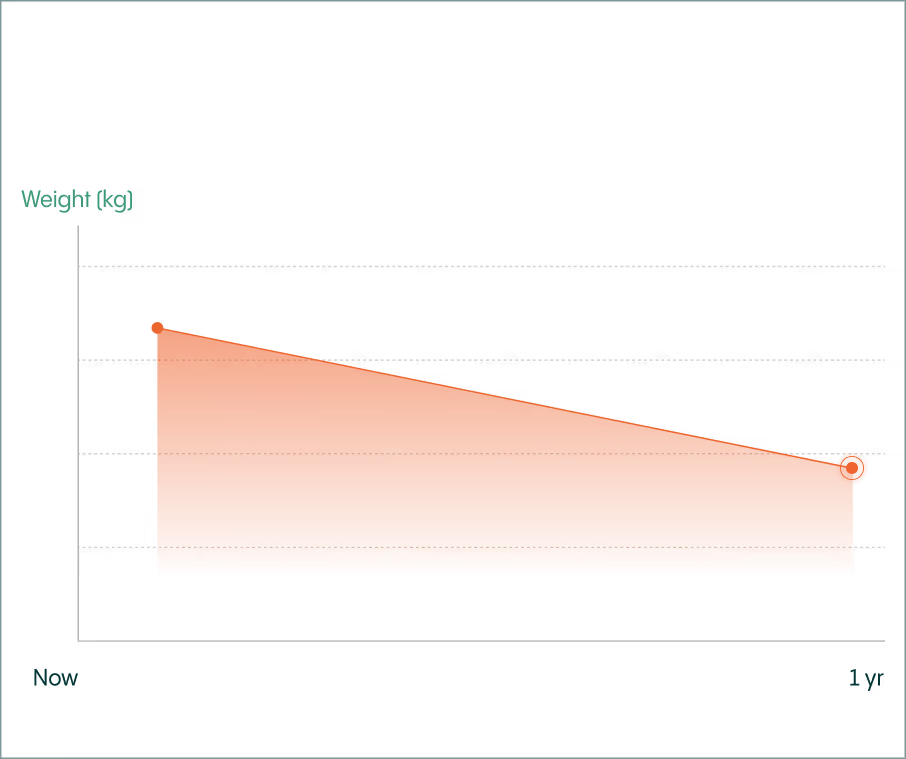
Because weight can contribute to low testosterone, a doctor will consider whether addressing weight could itself help levels — rather than assuming TRT is the automatic answer. For some men, meaningful weight loss may support healthier testosterone, potentially reducing or removing the need for treatment.
So identifying the cause shapes the plan. If weight is a major driver, tackling it may be the more useful first step; if there's a genuine deficiency beyond weight, treatment may be appropriate. A proper assessment tells the two apart.
The challenge with this loop is that it can feel self-perpetuating: low testosterone saps energy and motivation, making weight harder to manage, which may keep testosterone low. Men often feel stuck.
A doctor's role is to find the right point of intervention to break the cycle. Sometimes that's supporting weight management; sometimes, where a clear deficiency exists, treating it can help a man regain the energy to address weight. The right entry point is individual.
In untangling this, a doctor considers your testosterone levels and symptoms, the degree and pattern of excess weight, your metabolic health, other conditions, and your goals. They build a plan that addresses the real drivers rather than reaching reflexively for one solution.
This careful, individualised approach is why obesity and low testosterone need a doctor's assessment, not assumptions.
Whatever the plan, lifestyle is foundational. Nutrition, activity and sleep underpin both weight and hormonal health, and they support any treatment rather than being replaced by it. A doctor keeps these central to the strategy.
The encouraging flip side of this self-reinforcing loop is that it can be turned in your favour. Just as low testosterone and excess weight can compound each other, progress in one area can support the other. Even modest, sustained improvements — in weight, activity or sleep — may help, and where a genuine deficiency is treated, the energy regained can make weight management feel more achievable.
The key is finding the right place to push. For some men, supporting weight is the lever; for others with a clear deficiency, treating it provides the momentum to tackle weight. A doctor helps identify where to start so the loop begins working for you rather than against you. What feels like a stuck cycle from the inside often has a sensible entry point, which is precisely what a proper assessment is for.
If you're dealing with both excess weight and possible low testosterone and feel caught in the loop, a doctor can untangle it — identifying what's driving what and recommending the most sensible way forward.
A licensed doctor can assess the relationship, find the right intervention, and guide a coherent plan.
Speak to a licensed doctor on Noah to break the cycle sensibly. Start a consultation discreetly, and let a MOH-licensed Singapore doctor untangle the picture.
This article is for general education and is not medical advice. A consultation with a licensed doctor is required before any treatment.
Few relationships in men's health are as tangled as the one between body weight and testosterone.

Articles featured on Noah are for informational purposes only and should not be constituted as medical advice, diagnosis or treatment. If you have any medical questions or concerns, please talk to your healthcare provider. If you're looking for a healthcare provider, click here.