Hormonal Health
May 21, 2026
·
5 mins
read
Insomnia and Testosterone: The Hidden Two-Way Connection


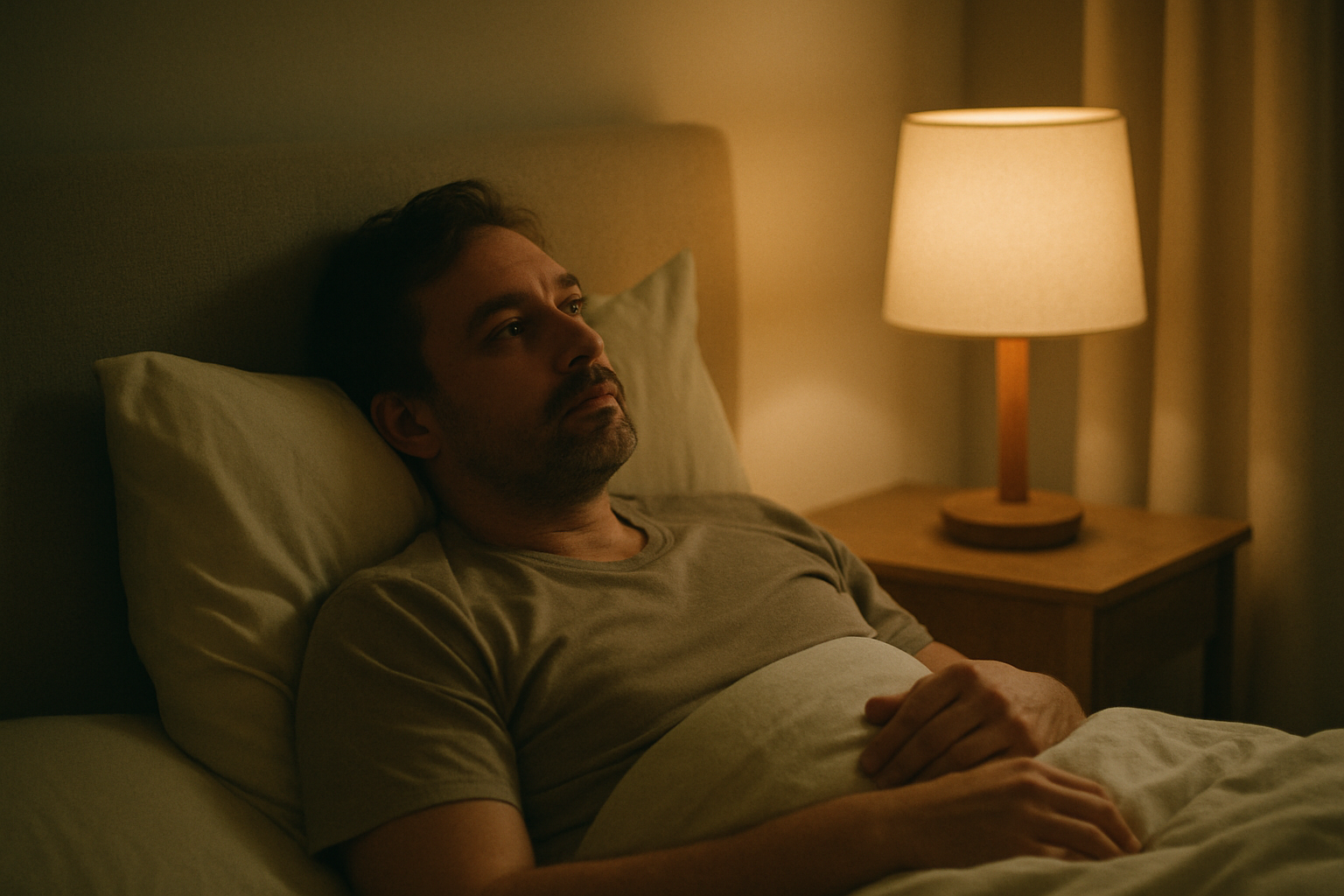
Most discussions of sleep and testosterone focus on how poor sleep lowers testosterone. The reverse is also true: low testosterone disrupts sleep, sometimes substantially. For some men, the relationship becomes a self-reinforcing loop. This guide explains the bidirectional connection, when to suspect a hormonal cause for insomnia, and what tends to help.
Most discussions of sleep and testosterone focus on how poor sleep lowers testosterone. The reverse is also true: low testosterone disrupts sleep, sometimes substantially. For some men, the relationship becomes a self-reinforcing loop. This guide explains the bidirectional connection, when to suspect a hormonal cause for insomnia, and what tends to help.
For the broader sleep-testosterone picture, see our main article on sleep and testosterone.
Testosterone affects sleep through several pathways. It supports the architecture of REM sleep, modulates the body's circadian rhythms, and influences the neurotransmitters that regulate the sleep-wake cycle. When testosterone is significantly low, REM sleep can become fragmented, total sleep efficiency can drop, and men often describe "unrefreshing" sleep even after spending enough time in bed.
Lower testosterone disrupts sleep. Disrupted sleep further lowers testosterone (most testosterone is produced during sleep, particularly REM). The loop can self-reinforce for years.
Breaking the loop usually requires addressing both ends: improving sleep behaviour and conditions where possible, and addressing hormonal causes where present.
Insomnia is more likely to be partly hormonal when it appears alongside:

In rough order of typical impact:
It can contribute, but rarely as the only cause. Most men with insomnia have other contributors too — stress, sleep environment, sleep apnoea, or substance effects.
In men whose insomnia has a hormonal component, addressing testosterone can meaningfully improve sleep quality over 4–8 weeks. Other contributors usually still need addressing too.
Melatonin can help with circadian timing issues and falling asleep, but doesn't address the underlying causes of disrupted sleep. Useful as one tool; not a complete answer.
If persistent sleep difficulties are part of a broader symptom pattern, you can book a confidential consultation with a Singapore-licensed doctor on Noah.

Articles on Noah are for informational purposes only and do not replace medical advice from a qualified doctor. To consult on Noah, click here. Noah's editorial standards are described on our editorial standards page.

Leproult R, Van Cauter E. Effect of 1 week of sleep restriction on testosterone. JAMA. 2011.
Wittert G. The relationship between sleep disorders and testosterone in men. Asian Journal of Andrology. 2014.
Bhasin S, et al. Endocrine Society Clinical Practice Guideline. JCEM. 2018.