Hormonal Health
May 21, 2026
·
5 mins
read
Hair Changes in Men: When It's Hormones, When It's Something Else


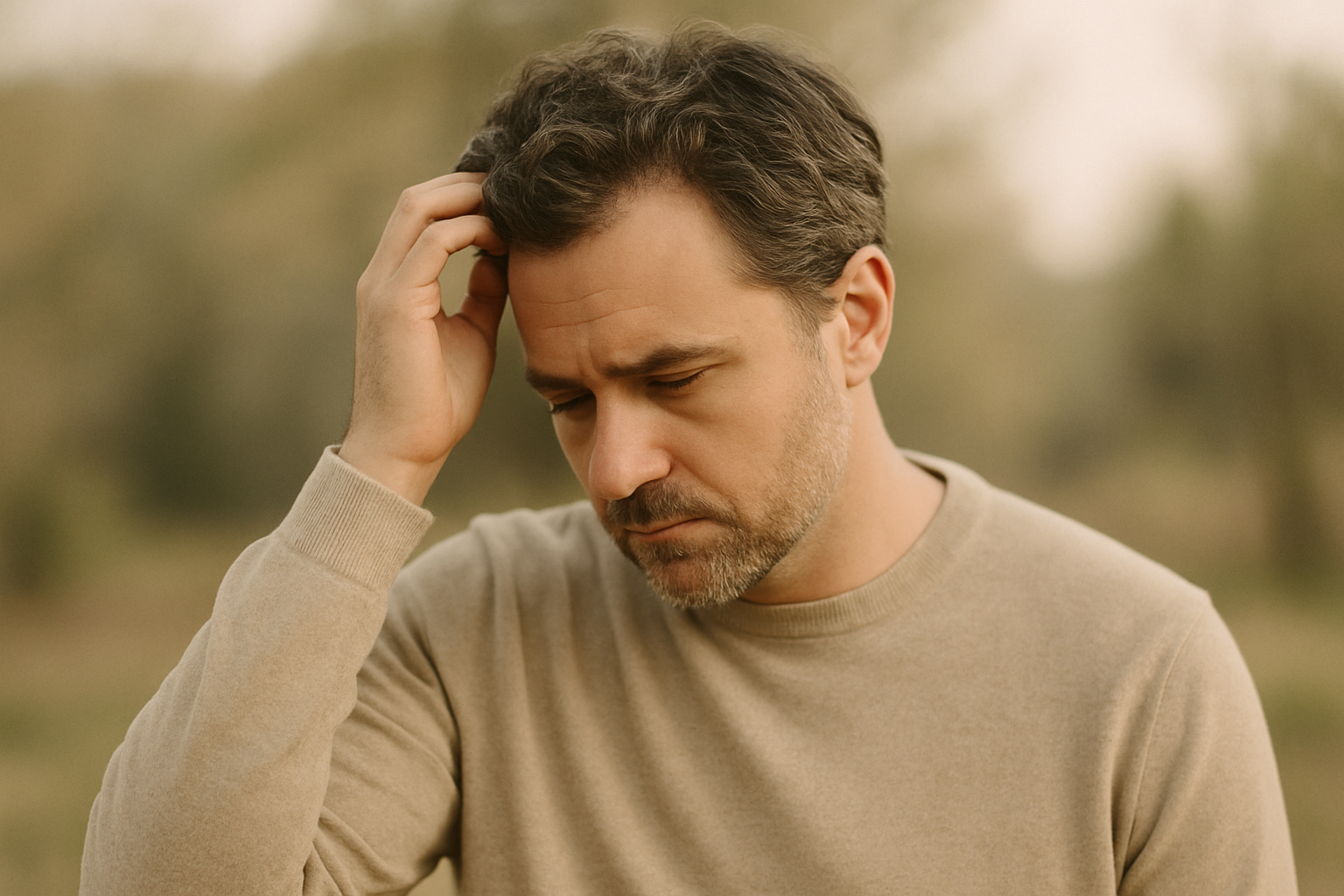
The relationship between testosterone and hair is more nuanced than the popular story suggests. Low testosterone does affect body and beard hair growth in some men; the better-known scalp hair loss in men (male pattern baldness) is driven by a related but distinct pathway. This guide untangles what each hair change typically signals.
The relationship between testosterone and hair is more nuanced than the popular story suggests. Low testosterone does affect body and beard hair growth in some men; the better-known scalp hair loss in men (male pattern baldness) is driven by a related but distinct pathway. This guide untangles what each hair change typically signals.
For broader context, see our complete guide to low testosterone and our hair loss treatment information.
Scalp hair thinning or balding in the classic pattern (receding hairline, crown thinning) is androgenetic alopecia. It is genetic and is mediated by dihydrotestosterone (DHT), a derivative of testosterone. Counterintuitively, men with male pattern baldness usually have normal testosterone levels — the issue is genetic sensitivity to DHT, not the amount of testosterone in the body.
Reduced body hair density (chest, abdomen, limbs, beard) can signal low testosterone. This is one of the more reliable hormonal hair signals, particularly when it represents a change from a more hirsute baseline.
Sudden or patchy hair loss, including loss of large sections of beard or eyebrow, can signal autoimmune (alopecia areata), thyroid, or other conditions. This pattern warrants medical assessment regardless of testosterone status.
The most common type of hair loss in men — androgenetic alopecia — affects roughly half of men by age 50. The cause is inherited sensitivity of scalp hair follicles to DHT, not abnormally high testosterone. Most men with male pattern baldness have completely normal hormonal profiles.
This is why TRT does not typically cause baldness or accelerate it in men with normal scalp hair, and why TRT does not restore lost hair on the scalp. The DHT pathway operates locally at the scalp, largely independent of overall testosterone levels in the body.
Body and beard hair growth depends on testosterone exposure during puberty and ongoing testosterone-related stimulation through life. Significant reductions in body hair density or beard growth — particularly when noticed alongside fatigue, low libido, mood changes, and other low-T symptoms — are one of the more specific hair-related signals of hormonal change.
In isolation, reduced body hair is not enough for a diagnosis; in combination with other symptoms, it warrants a testosterone test.
Not directly. Male pattern baldness is driven by genetic sensitivity to DHT at the scalp, not by high overall testosterone. Most balding men have completely normal testosterone levels.
In most men with normal scalp hair, TRT does not accelerate hair loss. In men already experiencing male pattern baldness, there is a theoretical concern that higher testosterone (and therefore more DHT) could accelerate it. The clinical evidence is mixed; for men starting TRT who have concerns, discussing with the doctor is reasonable.
Significant testosterone deficiency can slow beard growth and reduce density. Total beard loss is uncommon and would warrant looking at other causes too.
If hair changes are part of a broader symptom pattern you're noticing, you can book a confidential consultation with a Singapore-licensed doctor on Noah.

Articles on Noah are for informational purposes only and do not replace medical advice from a qualified doctor. To consult on Noah, click here. Noah's editorial standards are described on our editorial standards page.

Sinclair R. Male pattern androgenetic alopecia. BMJ. 1998.
Bhasin S, et al. Endocrine Society Clinical Practice Guideline. JCEM. 2018.